
Everything You Need to Know About the GMAT Enhanced Score Report (ESR) in 2026

Your official GMAT Focus Edition score report tells you what you scored. The Enhanced Score Report tells you why.
The ESR breaks your performance down to a level that the official report does not: how your accuracy shifted across the four quarters of each section, how much time you spent per question, where you were faster or slower than the benchmark, and which sub-topics cost you the most points.
For anyone retaking the GMAT, this is not optional information. It is the diagnostic foundation that separates targeted preparation from guesswork.
If you are not yet familiar with how the GMAT Focus Edition is structured, the complete GMAT Focus Edition guide covers the section structure, scoring, and key changes from the Classic GMAT before you dig into your ESR.
Have not taken the GMAT yet?
Take a free 7-question diagnostic test first. It will give you a section-wise score estimate and show you where your preparation gaps are before you invest in a full exam.
What Is the GMAT Focus Edition ESR and Should You Buy It?
The ESR is a supplementary performance report available separately from the official GMAT Focus Edition score report. You purchase it through your mba.com account for an additional $30, which is not included in the standard exam fee.
The official score report gives you your composite score (205 to 805) and your three section scores (60 to 90 each). The ESR adds the layer underneath: how your performance changed over time within each section, where you were accurate or inaccurate, and how your pacing compared to the benchmark.
Should you buy it? If you are planning a retake, yes. The $30 is the most cost-efficient investment you can make in your next preparation cycle. Without the ESR, you are retaking a 2.5-hour exam based on an impression of how it went. With the ESR, you have specific data on exactly where you lost points and why.
If you are satisfied with your score, the ESR is optional, though some students find value in understanding their performance patterns even without a retake planned.
What the GMAT Focus Edition ESR Measures
The ESR provides four layers of information for each of the three GMAT Focus Edition sections (Quantitative, Verbal, and Data Insights):
| ESR Parameter | What it tells you | Why it matters |
|---|---|---|
| Overall score and percentile | Your section score and how it ranks against recent test takers | Baseline for understanding where you stand relative to your target school’s median |
| Accuracy by quarter | What percentage of questions you answered correctly in each quarter of the section | Reveals pacing collapse, early errors, or late-section panic patterns |
| Average time per question | How long you spent per question overall and by question type | Identifies which question types are costing you disproportionate time |
| Sub-section scores | Performance broken down by skill area (e.g. Algebra, CR, Data Sufficiency) | Pinpoints the specific topics where your score is leaking |
Reading Your ESR Section by Section
The analysis differs by section. Select the section you want to interpret first.
Quantitative Reasoning: 21 questions, 45 minutes
The Quant section of the GMAT Focus Edition tests problem solving across arithmetic, algebra, geometry, and number properties. Data Sufficiency, which was previously in the Quant section, now sits within Data Insights.
Overall score and percentile
Sample image below is from a Classic GMAT ESR. The layout is similar in the GMAT Focus Edition.
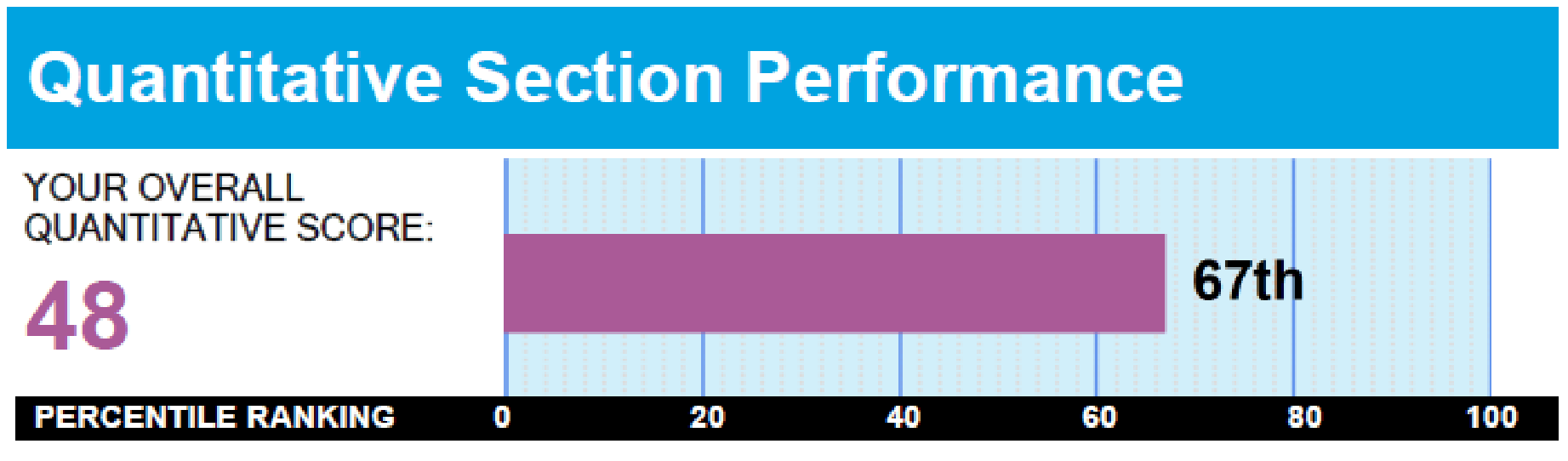
Your Quant score (60 to 90) comes with a percentile that tells you how you compare to test takers over the past three years. The Quant section is sensitive to accuracy: a one-point drop in your scaled score can reduce your percentile by several points at the competitive range.
Accuracy by quarter
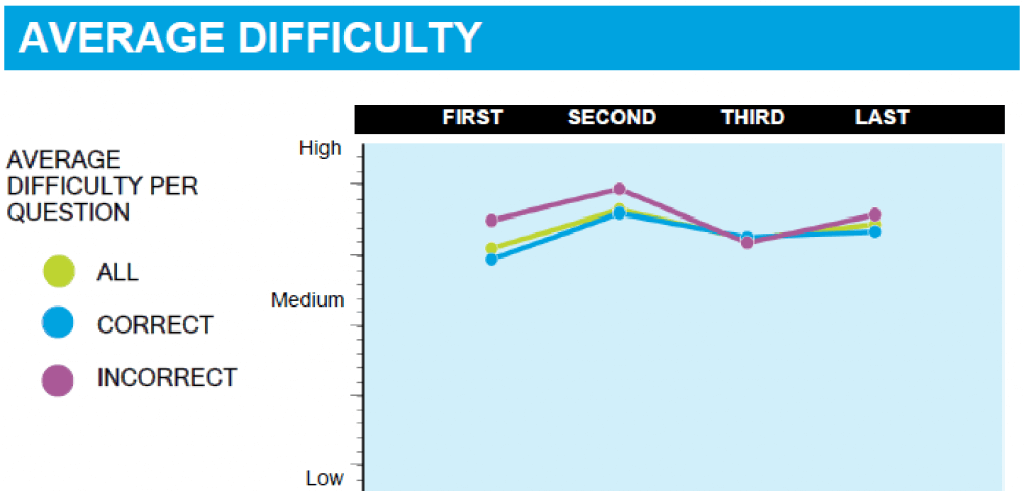
The GMAT Focus Edition is fully adaptive: your performance on early questions determines the difficulty level you receive later. If accuracy is lower in the first quarter, your score ceiling is constrained before the test has fully adjusted. The accuracy-by-quarter chart is the single most important diagnostic for Quant.
If accuracy in Q3 or Q4 drops relative to Q1 and Q2, you likely ran out of time and rushed. If Q1 accuracy is the lowest, the adaptive algorithm pulled your score down early and you never fully recovered.
Time management by quarter
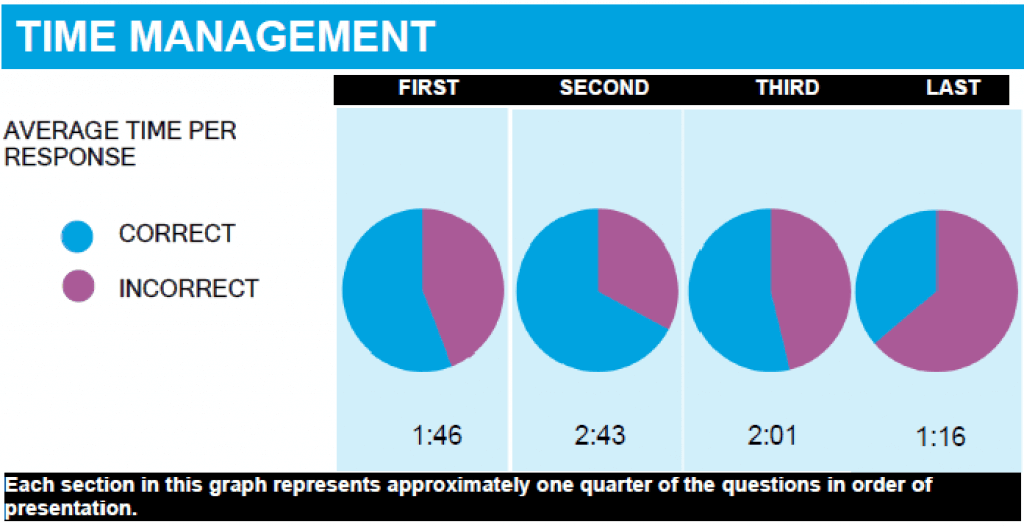
The benchmark for Quant is approximately 2 minutes 8 seconds per question. If you spent significantly more time on certain quarters, that extra time had to come from somewhere else. The time-by-quarter chart will show whether you borrowed from later questions to get earlier ones right.
Sub-section skill breakdown
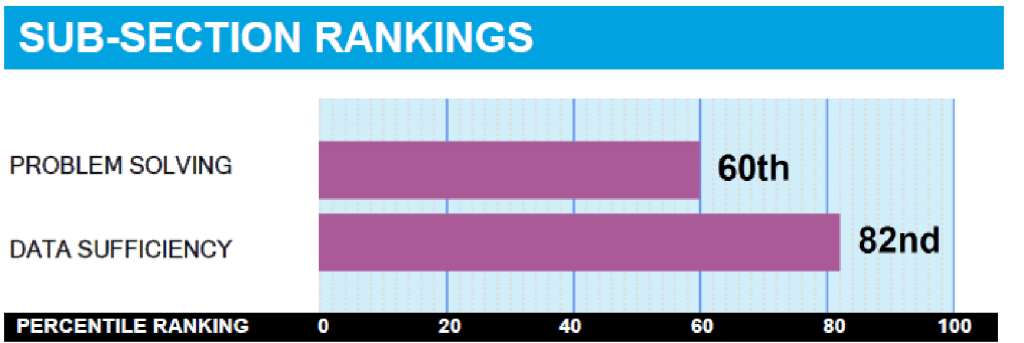
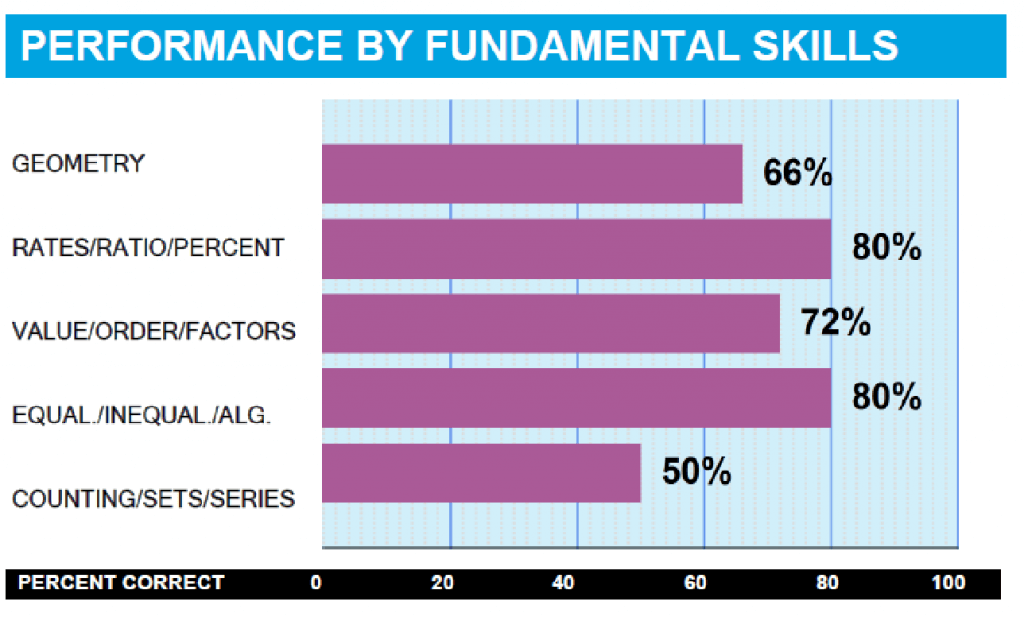
This is where the ESR tells you which specific topic to fix. If Algebra is showing lower accuracy and higher time per question, those two signals together confirm it is a priority area. A topic with slightly lower accuracy but normal timing is usually a knowledge gap. A topic with normal accuracy but excessive timing is usually a process efficiency problem.
Verbal Reasoning: 23 questions, 45 minutes
The GMAT Focus Edition Verbal section covers Critical Reasoning (CR), Reading Comprehension (RC), and Sentence Correction (SC). The ESR shows your performance in each of these sub-types, which is where the most actionable insights come from.
Overall score and percentile
Sample image below is from a Classic GMAT ESR. The layout is similar in the GMAT Focus Edition.
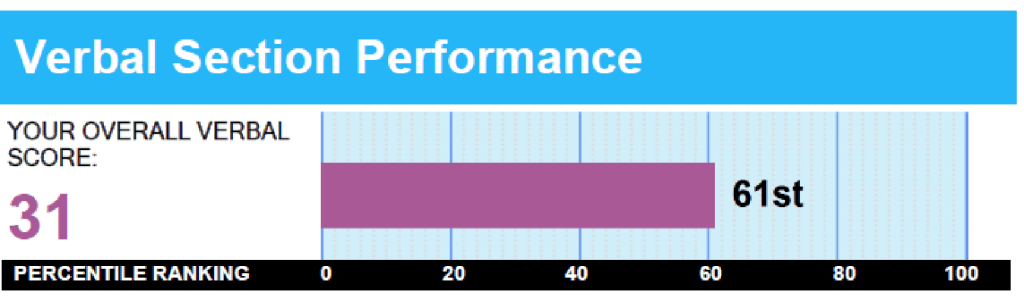
Your Verbal score (60 to 90) reflects performance across all three question types. A score of 31 on the Classic GMAT corresponded to the 61st percentile. On the GMAT Focus Edition, the scoring scale is different (60 to 90), but the percentile interpretation works the same way.
Accuracy by quarter
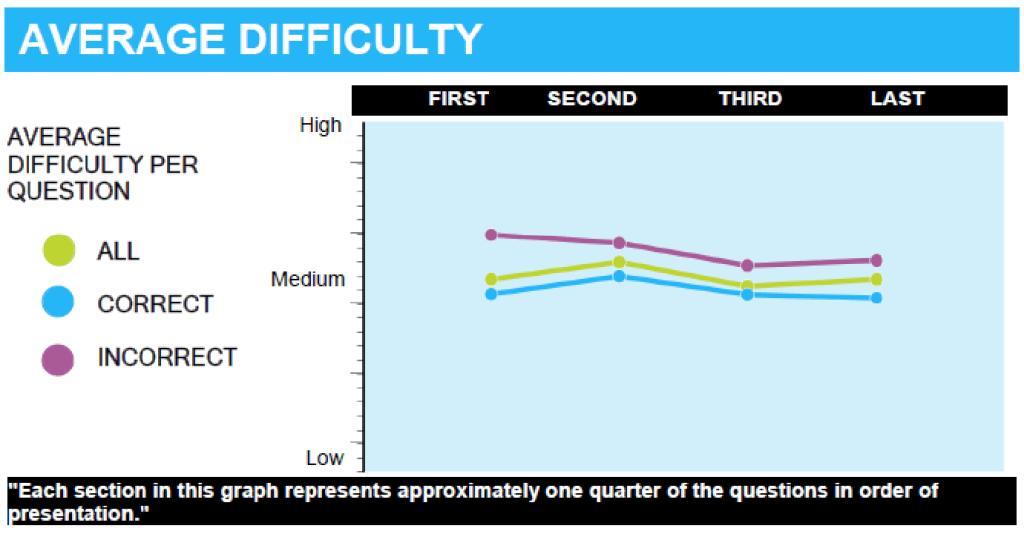
The adaptive nature of the Verbal section means early errors are costly. If accuracy in Q1 is below 50%, you have likely set a lower difficulty trajectory for the rest of the section.
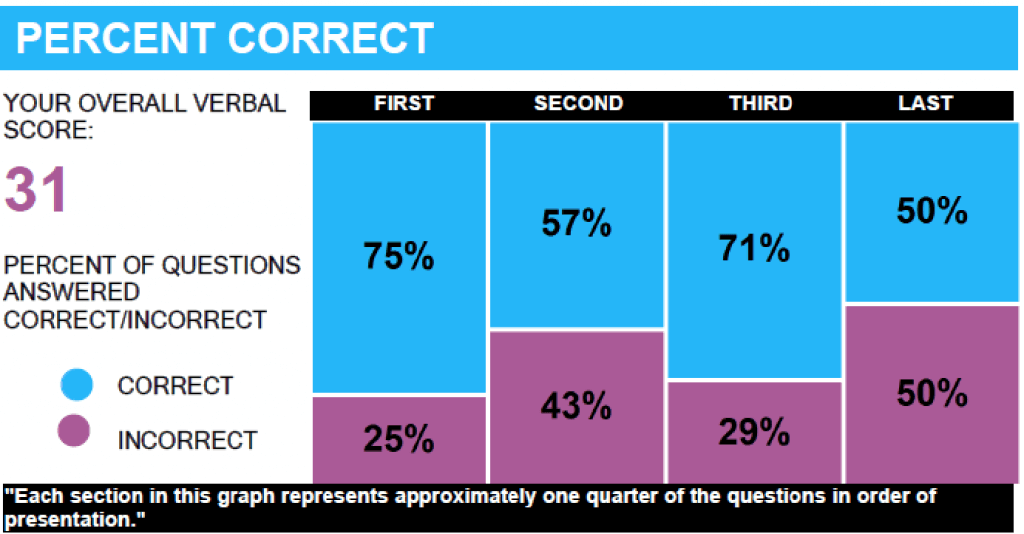
A drop in accuracy in Q4 with a corresponding drop in time per question usually means late-section rushing. The student ran short on time and guessed to complete the section. The fix is a pacing strategy, not more content review.
Time management by sub-type
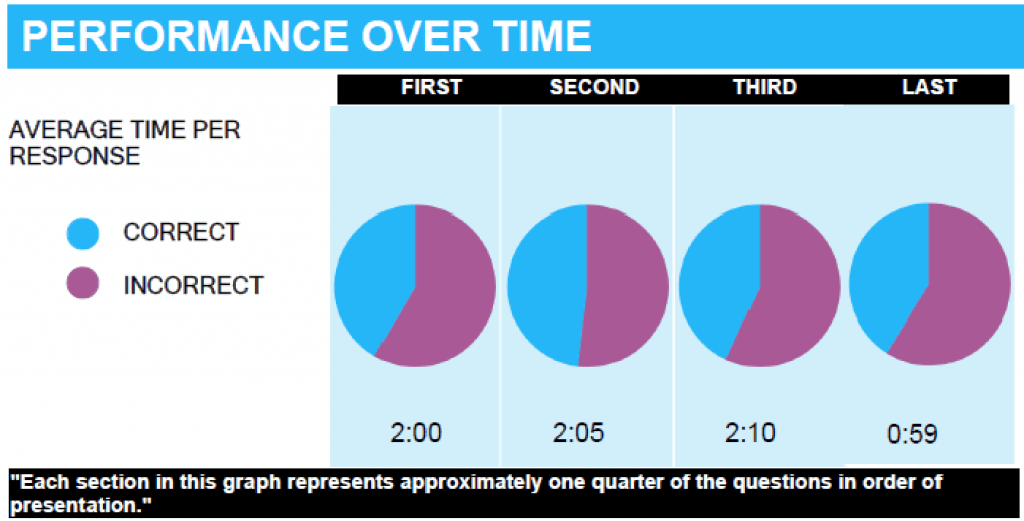
The benchmark for Verbal is approximately 1 minute 57 seconds per question. CR questions tend to take longer than SC for most test takers. If your ESR shows CR averaging 30 or more seconds above your SC average, that is the root cause of many pacing problems in the Verbal section.
Sub-section skill breakdown
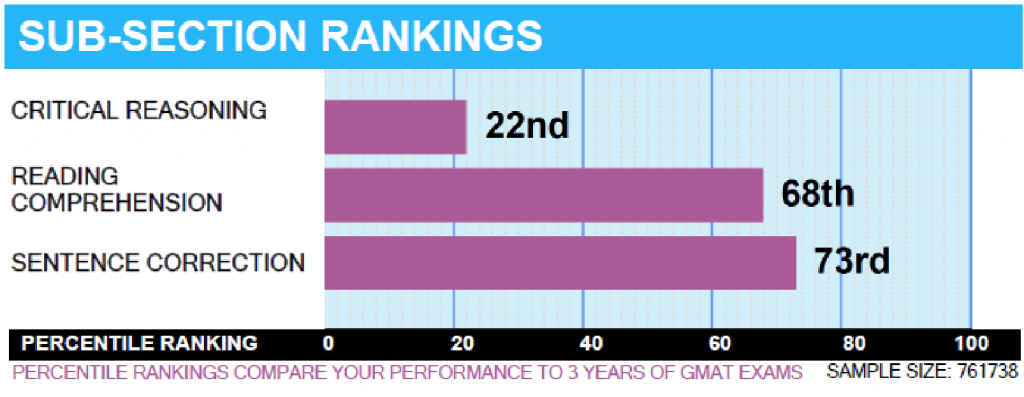
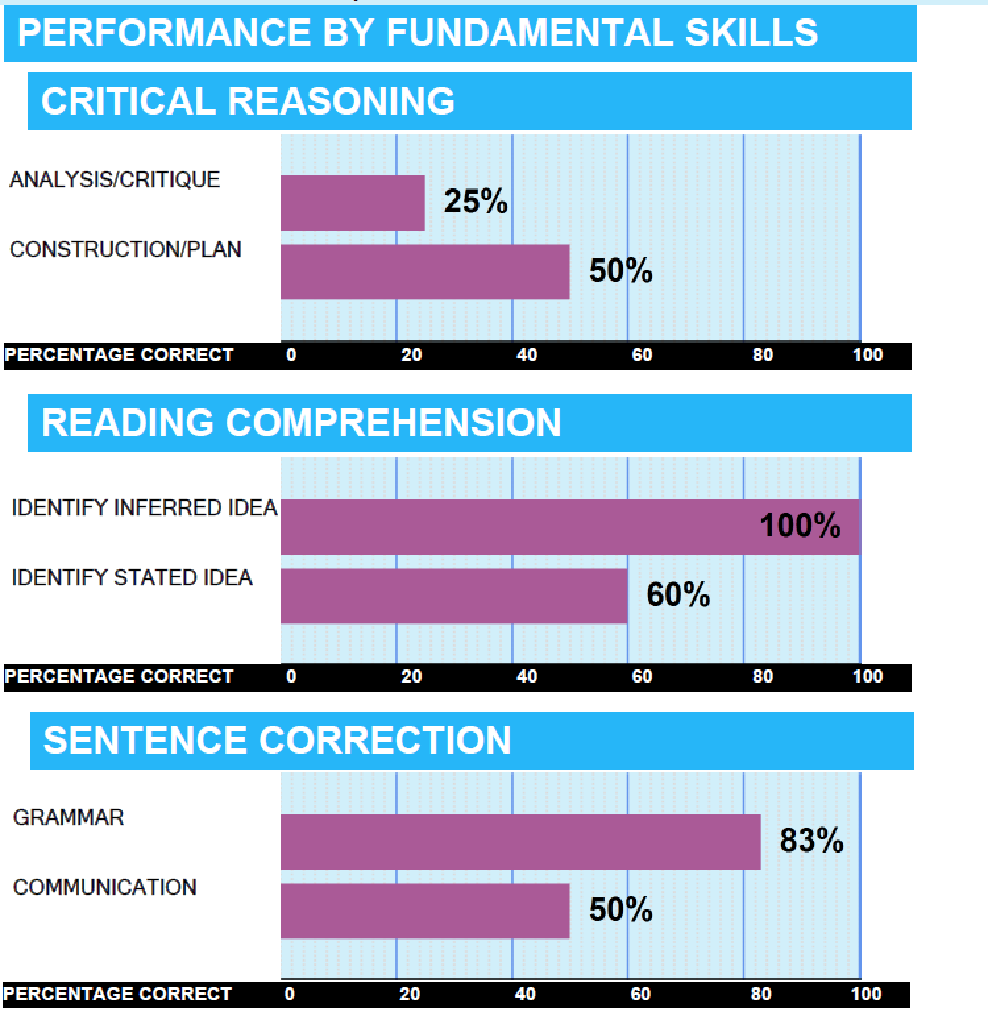
CR is the most common weak area in the Verbal section. If your ESR shows a sub-50% accuracy rate in CR alongside above-average time, it usually points to over-analysis rather than a knowledge gap. The guide on GMAT Critical Reasoning covers the most common reasoning errors and how to resolve them quickly.
Data Insights: 20 questions, 45 minutes
The Data Insights section is unique to the GMAT Focus Edition. It covers five question types: Data Sufficiency (DS), Multi-Source Reasoning (MSR), Table Analysis, Graphics Interpretation, and Two-Part Analysis. The ESR shows your performance across these types, which vary significantly in difficulty and time demand.
Overall score and percentile
Sample image below is from a Classic GMAT ESR showing an IR/DI-type section. The layout is similar in the GMAT Focus Edition.
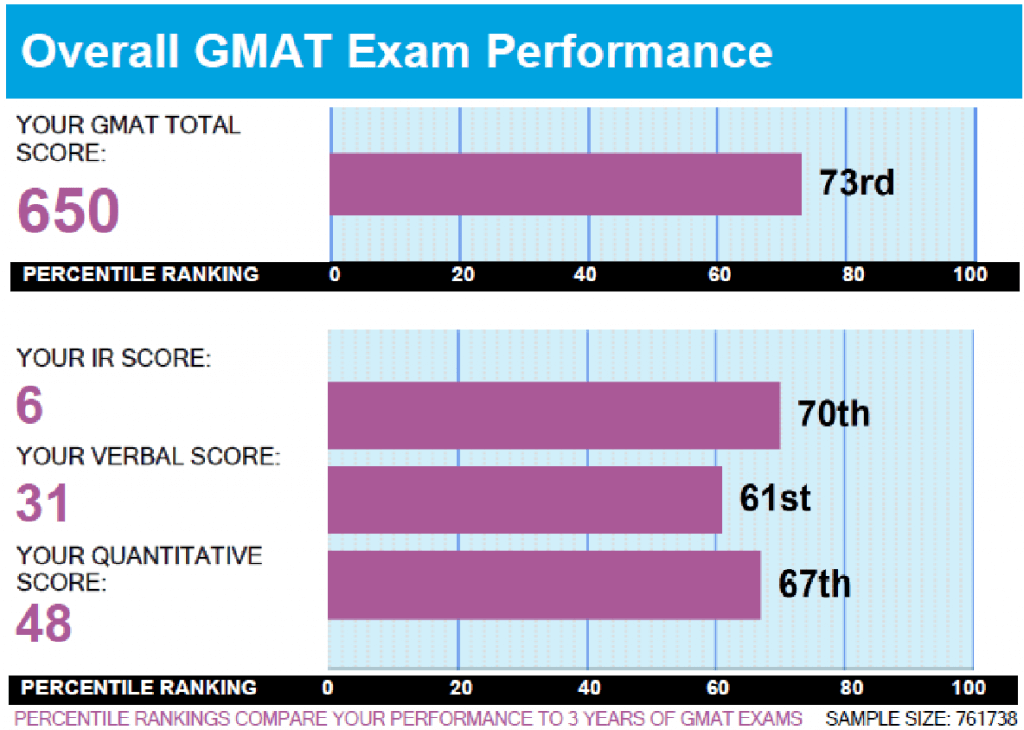
Your DI score (60 to 90) is the section where most test takers have the least preparation data. Because DI combines analytical reasoning with data interpretation, the sub-type breakdown is particularly important for understanding where to focus.
Accuracy and time by question type
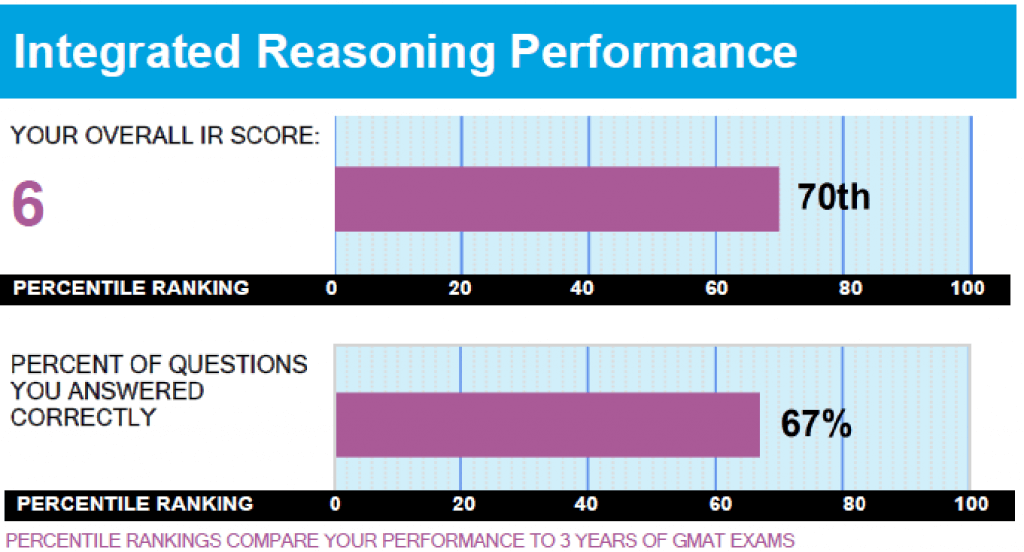
The benchmark for Data Insights is approximately 2 minutes 15 seconds per question on average. However, this masks significant variation: Table Analysis and Graphics Interpretation questions are typically faster (90 to 120 seconds) while MSR and Two-Part Analysis questions regularly take 3 to 4 minutes. Your ESR time breakdown by question type will show whether your pacing strategy accounts for this variation.
Data Sufficiency questions within DI are the highest-leverage area to improve. They appear frequently, they are solvable with the right framework, and many test takers make consistent errors (such as assuming information from Statement 1 when evaluating Statement 2) that the ESR accuracy chart will confirm.
For a full breakdown of each DI question type and how to approach them, the GMAT Data Insights guide covers all five question types with worked examples.
What Your GMAT Focus Edition Scores Actually Mean
Before you can use your ESR effectively, you need a reference frame for where your scores sit. The bands below show how GMAT Focus Edition composite scores (205 to 805) map to competitive ranges.
Below 50th percentile
Significant improvement needed for most programs
50th–70th percentile
Competitive for regional programs; below median for top schools
70th–85th percentile
Competitive range for most top Indian programs (ISB median ~710)
85th–95th percentile
Strong for ISB, IIM; competitive for global top-20
95th+ percentile
Strong for M7, INSEAD, LBS
For section scores (each on a 60 to 90 scale), a score of 85 or above in any section is typically above the 85th percentile. Scores below 75 in any section are worth addressing specifically.
For a detailed mapping of section scores to composite scores and percentile equivalents, the GMAT score chart guide has the full breakdown.
GMAT Focus Edition Pacing Benchmarks
One of the most actionable parts of the ESR is the time-per-question data. Use the tool below to check whether your pacing was on track.
Check Your Pacing Against the Benchmark
Enter your average time per question from your ESR for each section.
The milestones below give you target checkpoints during each section. If you are consistently behind at the first checkpoint, time pressure in the later quarters is almost certain.
| Section | Time remaining: 33 min | Time remaining: 21 min | Time remaining: 9 min |
|---|---|---|---|
| Quantitative (21 questions) | 5 questions done | 11 questions done | 17 questions done |
| Verbal (23 questions) | 6 questions done | 12 questions done | 18 questions done |
| Data Insights (20 questions) | 5 questions done | 10 questions done | 16 questions done |
Want an expert to read your ESR with you?
Our mentors review your ESR alongside your practice test history to build a specific study plan. This is GMAT personal coaching that starts from data, not assumptions.
How to Turn Your ESR Into a Study Plan
An ESR is only useful if it changes what you do next. Work through the steps below after receiving your report.
- Identify your lowest-scoring section. This is your primary investment area. If one section is significantly below the others, bringing it up has the most composite score impact.
- Check the Q1 accuracy for each section. If accuracy in the first quarter is below 60%, the adaptive algorithm started routing you toward lower-difficulty questions early. The fix is not speed. It is accuracy on the first 5 to 6 questions.
- Compare your average time to the benchmark. For each section where you were significantly over or under the benchmark time, identify the quarter where the deviation started. Over-time in Q2 almost always means rushed Q4.
- Identify the one or two sub-topics with the worst accuracy-to-time ratio. A topic with low accuracy AND high time is your highest-priority area. A topic with low accuracy but normal time is a knowledge gap. A topic with high accuracy but high time is a process efficiency issue.
- Build a 4-week plan around no more than three focus areas. Trying to fix everything at once produces shallow improvement everywhere. Fixing three specific things produces measurable score movement.
- Retake a full practice test after four weeks and compare section-level metrics. You are looking for accuracy improvement in the problem areas and time normalisation. If accuracy improved but time increased, you have more to go. If both improved, you are ready to target the next gap.
For a structured template to organise your preparation around ESR insights, the GMAT study schedule guide gives you a week-by-week framework you can adapt to your specific gap areas.
Can You Access the ESR for a Canceled GMAT Score?
Yes. If you canceled your GMAT Focus Edition score, you can still purchase and access the ESR using your ESR authentication code. The cancellation affects what is submitted to schools. It does not affect your ability to review your own performance data.
The one exception is if scores were revoked due to a policy violation. In that case, ESR access is not available.
Note that ESR authentication codes are sometimes issued 48 to 72 hours after the test, occasionally longer. If the code has not arrived within three days of your test date, contact GMAC support directly.
“After my first attempt I thought my Quant was weak across the board. My ESR showed something more specific: my Q3 and Q4 accuracy dropped because I had spent too long on three Algebra questions in Q2. Once I knew that, the fix was obvious. I retook six weeks later and improved by 40 points.”
Scored below your target? Your ESR is the starting point.
The practical guide on how to improve your GMAT score walks through the full improvement framework. If you want someone to apply it to your specific ESR, our mentors can do that in a single session.
Frequently Asked Questions About the GMAT ESR
The GMAT ESR is available for $30, purchased separately from your exam registration fee through your mba.com account. It is not included in the standard GMAT Focus Edition fee. Verify current pricing at mba.com, as GMAC occasionally updates its fee structure.
Buy the ESR as soon as you have your score and know you are either planning a retake or want to understand your performance in detail. There is no benefit to waiting. The ESR data is most useful when your test experience is still fresh and you can cross-reference what you remember with what the data shows.
No. The ESR does not identify individual questions or show you the correct answers. It shows aggregate performance patterns: accuracy rates by quarter, average time per question by sub-topic, and sub-section skill scores. This is enough to diagnose the problem area without revealing the specific questions, which GMAC does not make available.
The GMAT Focus Edition ESR reflects the new three-section structure: Quantitative Reasoning, Verbal Reasoning, and Data Insights. The Classic GMAT ESR covered four sections including the AWA and what was then called Integrated Reasoning. The Focus Edition ESR no longer includes AWA data (AWA was removed from the Focus Edition entirely). Data Insights replaces the old IR section and has its own sub-type breakdown in the ESR covering DS, MSR, Table Analysis, Graphics Interpretation, and Two-Part Analysis.
Yes, especially then. If you have limited retake attempts, the ESR gives you the clearest possible picture of what to fix before your next and final attempt. The $30 investment is trivial compared to another exam registration fee ($275) and months of preparation. Going into a final retake without ESR data means you are optimising based on memory and instinct rather than actual performance patterns.
The One Thing Most Test Takers Do Wrong With Their ESR
They look at the sub-section scores, find their lowest area, and spend all their time drilling that topic. That is not wrong, but it is incomplete.
The more important signal is usually the accuracy-by-quarter chart. If your accuracy drops in Q3 or Q4 of a section, you do not necessarily have a content problem. You have a pacing problem. No amount of topic drilling will fix that. What fixes it is practicing with timed conditions until your internal clock is calibrated to the benchmark.
Read your ESR in this order: timing first, accuracy second, sub-topics third. That sequence will tell you whether your score is limited by pacing, knowledge, or a specific weakness, and that distinction determines whether you need to practice differently, study more, or study different content.
Scored below 700 and not sure what to fix?
Share your ESR with one of our mentors. A single session is usually enough to build a specific improvement plan for your retake.
Your target score starts with
one expert call.
A free 30-minute call. We'll audit your prep, find your gaps, and build a roadmap to your target score.