

.webp)


.webp)
Problem 01
Vocabulary memorized. Context ignored.
You can recite 500 GRE words and still get Text Completion wrong, because the GRE tests how words behave in a sentence.

Your mock and section scores decide how much of your time goes to Quant and how much to Verbal, and you work through it with Devmitra or Nitha directly.
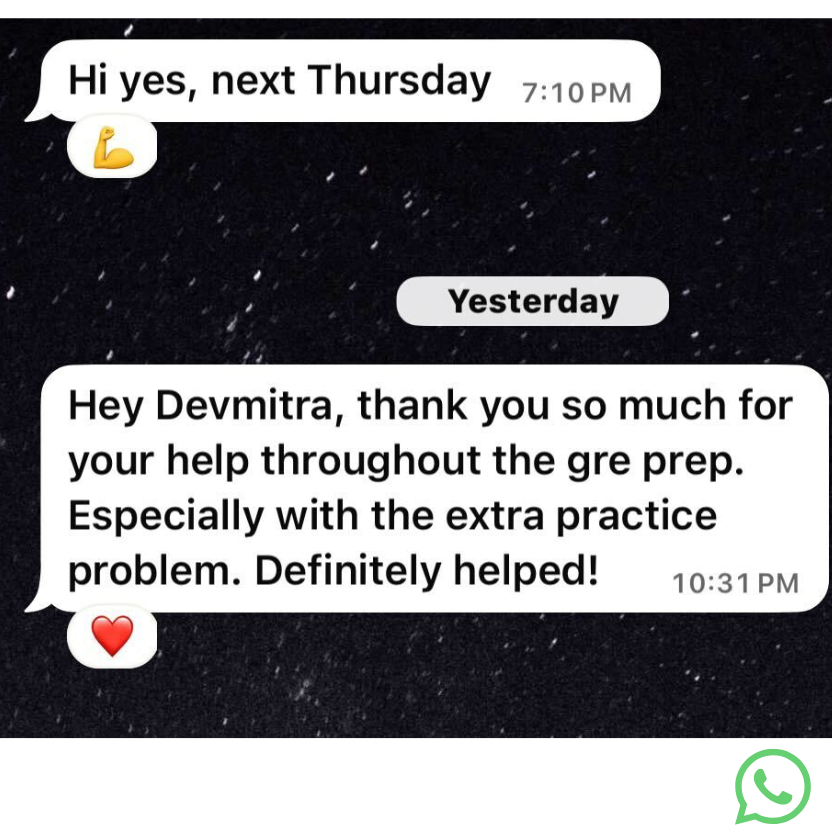
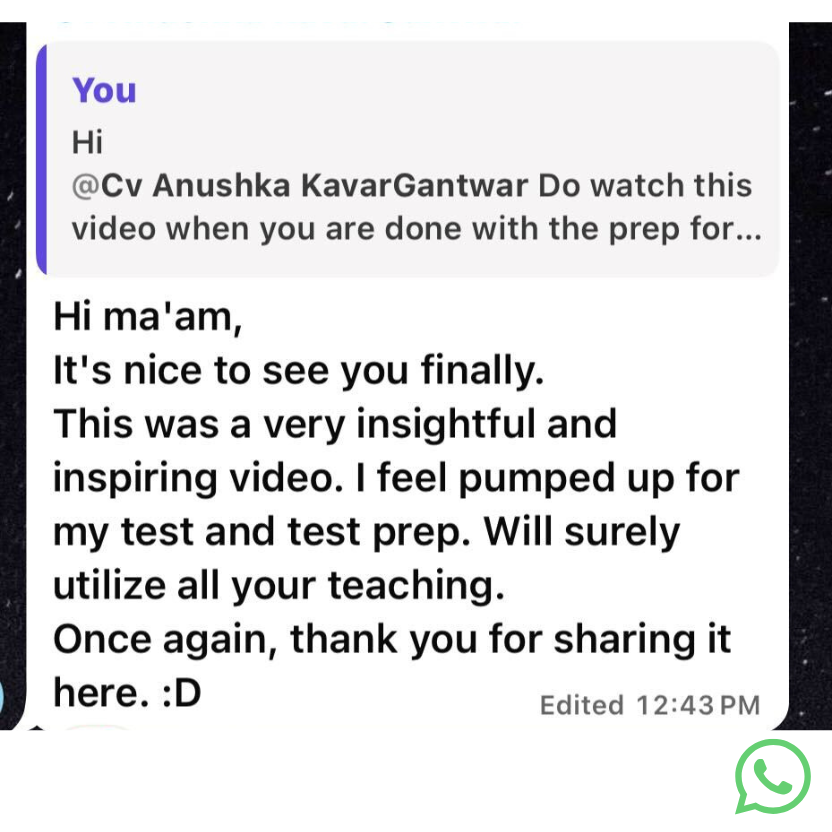
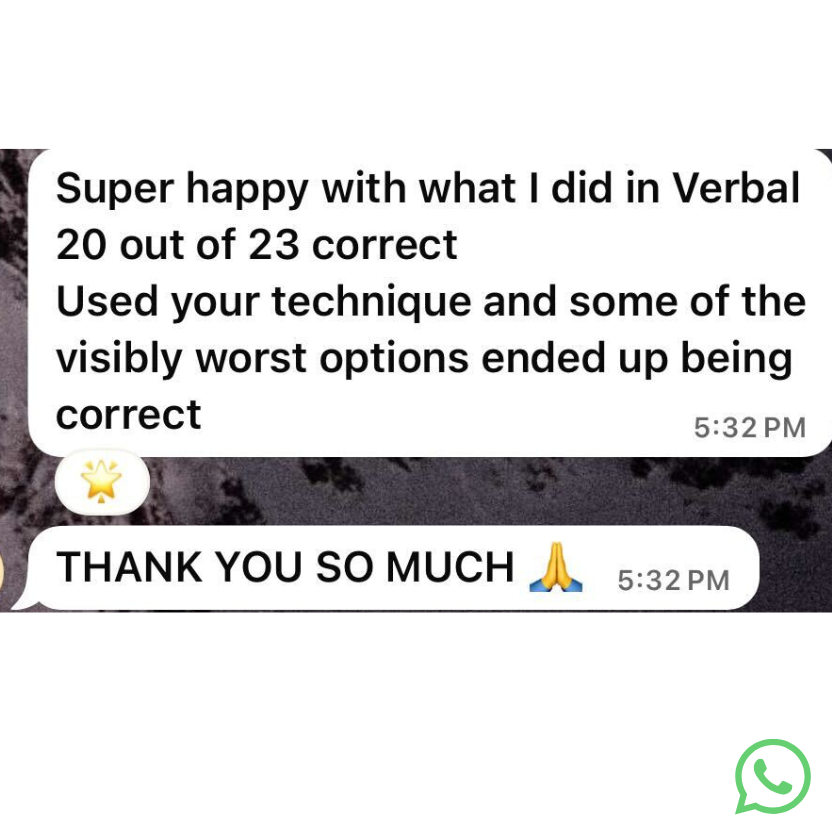
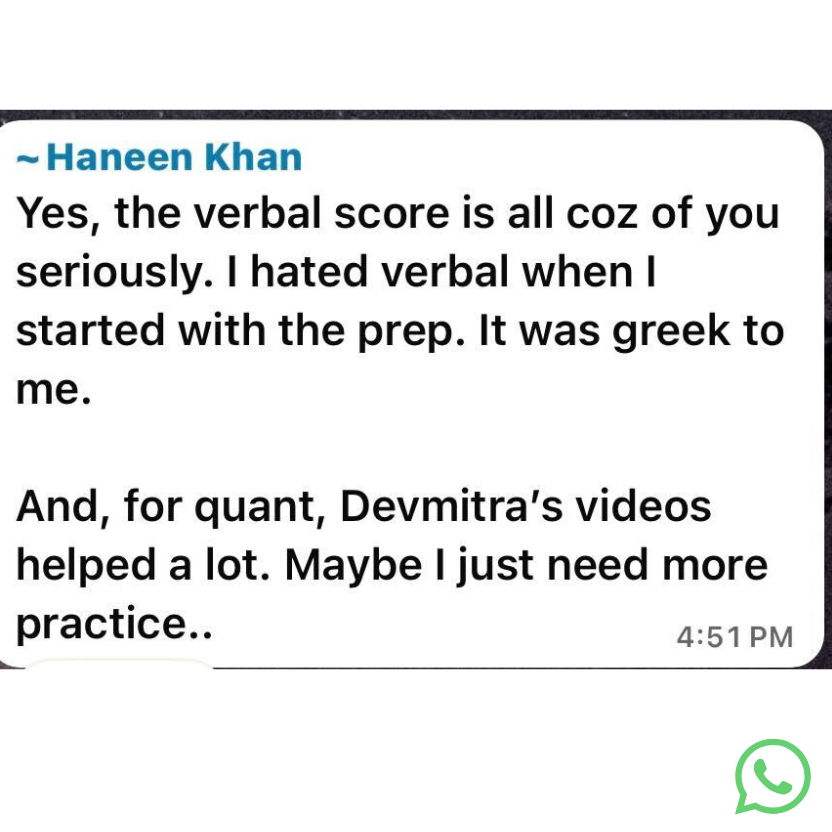
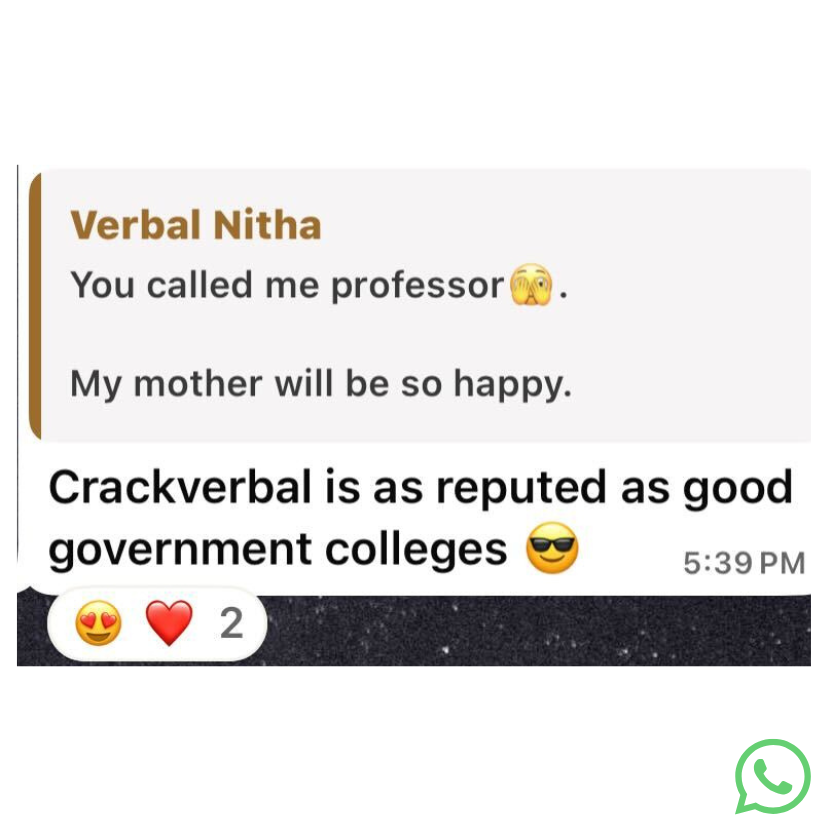
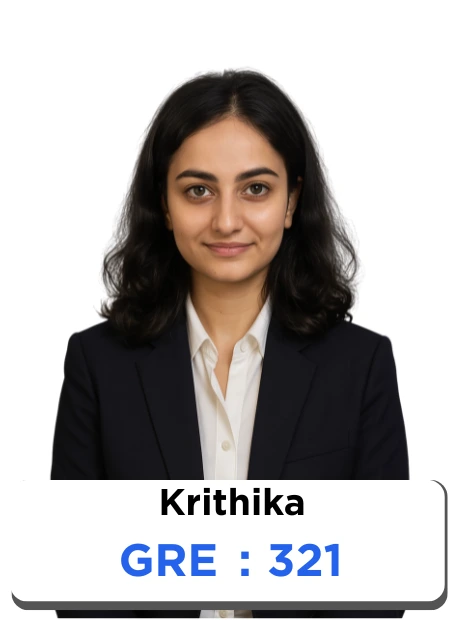
"I had done two months of self-study before this. The verbal framework here was completely different. I stopped guessing."
"I was stuck in Quant. I had the math. The issue was time. Three sessions changed how I approached every section."
GRE accepted at
Most GRE prep focuses on content, but content is rarely the problem for students who are already putting in the hours.
You can recite 500 GRE words and still get Text Completion wrong, because the GRE tests how words behave in a sentence.
You know the concepts, but in a timed section you stall. Efficient test-taking is a separate skill, and almost nobody trains it explicitly.
This is the one that wastes months. Without section-level scores you cannot tell whether your missing points are in Quant or Verbal, so you split your time evenly and under-invest in the section that is actually bleeding.
Most students who come to us have already done the flashcards. They know hundreds of words and still get questions wrong, because knowing a word and using it in a GRE sentence are two different skills. Here is what we do about that.
Most students also forget that Reading Comprehension and the AWA essay carry just as much weight on GRE Verbal as vocabulary does. We teach all three.
Here's how we teach GRE Verbal:
Most GRE word lists are alphabetical. Students start at A, push through B, and quit somewhere in C, with most of the important words still unlearned. We arrange the same words differently: highest-frequency first, in small installments, so you always know exactly what to learn today.
Day one is Lesson 1: ten ways to praise. Here it is, exactly as our students see it inside the course:
Each lesson makes you prove what you just learned. You answer question after question on words that seem to mean the same thing, then clear a short test before the lesson ends. Knowing fewer words in this much detail beats knowing a hundred more vaguely. One question, straight from Lesson 1:
Which word means to praise with formal, often religious, reverence?
All four mean praise. Extol is enthusiastic praise. Acclaim is public approval. Lionize is celebrity treatment. Venerate is kept for figures of moral or historical weight. The GRE expects you to know the difference. Flashcards will not get you there. This will.
Once you finish a block of lessons and their quizzes, you meet your verbal mentor one-on-one. Your mentor discusses GRE-style questions with you: why the wrong word tempted you, what pointed to the right one, and how the sentence was built.
That last part matters more than students realize: the GRE hides its clue in the construction of the sentence. Read the construction right, and the word follows.
After every session come practice tests, and the tests keep teaching. Every option in every question is defined, shown in a sentence, and explained. Each test also brings in words the lessons never covered, so your vocabulary grows even while being tested. Try one from the actual course:
Although the novelist's prose style was widely regarded as _________, her plots were so intricately constructed that even readers who found the writing difficult could not put the books down.
The clue is not the "although". It sits in the second half: readers "found the writing difficult". So the prose must be demanding.
"I had learnt lucid and pellucid as two separate flashcards, months apart, and never connected them. The lesson put them side by side and showed me the difference in one line. No word list ever did that for me."
Radhika · GRE Personal Tutoring student, on WhatsApp
This cycle runs through the whole program: lessons, session, practice tests, repeat. Every session covers every question format, including the triple-blank questions most students dread, right from your first session. What goes up is the difficulty.
Is this the kind of prep you have been looking for?
Two question types cost students the most: "select all that apply", where any number of options can be correct and there is no partial credit, and inference, where the trap answer sounds reasonable but is never actually said in the passage.
The fix starts before the questions do. Your mentor trains you on what to pick up while reading: the author's opinion, where the passage turns, which details exist only to support a claim. Read this way, and both question types open up, because you know where to look and what to eliminate.
Students treat the essay as an afterthought. Admissions committees use it as a check: it is the only writing they know you produced alone, under exam conditions. A low score can make them re-read your SOP and wonder who wrote it. A strong one backs up your whole application, and steadies it when your verbal score falls short.
It is also the easiest score to improve with feedback. Your mentor reads every essay and tells you what the argument misses, where the writing weakens, and what to fix next. Very few programs review essays at all. Here it is part of the syllabus, and our mentors coach students toward the top of the scale.
You stop guessing between the last two options, because you know what separates the words. Hard sentences stop scaring you, because you have a method for them. And you find your weak areas weeks before the exam, instead of inside it. That is what moves a verbal score.
The GRE never asks what a word means. It asks which word fits this sentence. That is the skill every lesson, session, and test here builds.
Every block of lessons ends in quizzes and a session with your mentor. You meet each word again before it fades, so remembering does not depend on willpower.
Your mentor sees every quiz, every mock, and every essay. Your plan changes based on what you get wrong. Self-study can never give you that.

In July 2024, Crackverbal co-founder Arun Jagannathan appeared on Stanford GSB's Grit & Growth podcast. He discussed how entrepreneurs can navigate the AI revolution, drawing on how Crackverbal uses AI in test prep and admissions.
Read the Stanford featureEvery session you pay for is taught by one of these two. There is no junior faculty tier and no batch you get assigned to.
.png)
Devmitra turns test-prep overwhelm into a structured plan. She specializes in non-quant backgrounds. 10+ years, 3,000+ students, one approach: structure first, confidence follows.
.png)
Nitha approaches verbal the way a storyteller would. She helps students understand how GRE questions are designed, why traps exist, and what the test is actually measuring. The Text Completion question on this page is one of hers.
Nobody can answer that before seeing your scores. We tell you the number, what each session covers and the total before you pay.
Twenty minutes, and it gives you a section-level breakdown.
A batch is cheaper per hour and right for plenty of students. This is where the difference actually shows up, so you can tell which one you are.
| Crackverbal one-to-one | Group batch coaching | Self-study | |
|---|---|---|---|
| Who decides what you study | ✓ Your mock scores do | ~ A fixed syllabus does | ✕ You do, with no section data |
| Your Quant–Verbal time split | ✓ Set by your section scores | ✕ Identical for everyone in the batch | ✕ Usually split evenly by default |
| Who teaches your sessions | ✓ Devmitra or Nitha, every session | ~ Whoever is assigned to that batch | ✕ Nobody |
| Pace | ✓ Yours | ✕ The batch's | ~ Yours, with no feedback loop |
| Mock review | ✓ Question by question with your mentor | ~ Group doubt session | ✕ Score report only |
| MBA admissions help after the GRE | ✓ In-house team available | ✕ Test prep only | ✕ Not available |
| Price | ✓ ₹5,000 a session, taxes in | ~ Cheaper per hour, fixed package | ✓ Books only |
₹5,000 per session, and that figure includes all taxes, so nothing is added at checkout. A session is one hour of one-to-one time with Devmitra or Nitha. Because the right number of sessions depends on your current score and the gap you need to close, tutoring is priced per session rather than as a fixed package.
We will not guess at it before seeing your mock and section scores, because the honest answer depends entirely on where your points are going. The order is: we look at your scores with you, and then we tell you the number of sessions, what each covers, and the total cost. You see all of that before you pay anything.
It is one-to-one. There is no cohort, no batch start date and no fixed weekend timetable to fit into. Every session is you and one mentor, scheduled around your week. If you are looking for a live batch program instead, our GMAT Live Online course runs that way, but GRE preparation at Crackverbal is one-to-one only.
Devmitra Sen for Quantitative Reasoning and Nitha Jayachandran for Verbal. Both lead the academic side of Crackverbal rather than teaching alongside a bench of junior faculty, and both have LinkedIn profiles and recorded methodology sessions linked on this page so you can see how they teach before you book.
By your mock and section scores, not by a standard syllabus. A student losing eight points in Quant and two in Verbal gets a very different program from someone in the reverse position, and the split gets adjusted as your section scores move through the program. This is the main thing one-to-one buys you over a batch, where the allocation is the same for everyone in the room.
Yes, and one-to-one is easier to do around a job than a batch is, because sessions are scheduled to your availability rather than to a fixed weekend slot. Most working students find that consistent study time of roughly eight to ten hours a week works better than trying to compress everything into weekends. We build a realistic plan around your week before you start.
For most working professionals and final-year students, eight to twelve weeks of steady effort is enough to build both Verbal and Quant skills, work through mock tests, and review the gaps with a mentor. The exact timeline depends on your starting score and how much time you can commit each week. A structured plan built around eight to ten hours a week usually outperforms an intense short-term push.
Flashcards help you recognize words. They do not help you work out how the GRE is using them. Our Verbal method teaches you to read context, tone and sentence structure to arrive at the correct word even when you have not seen it before. The Text Completion question on this page is a worked example, and the point of it is that the contrast word "although" is not the clue. The clue is the phrase telling you readers found the writing difficult. That matters most in Text Completion and Sentence Equivalence, where the answer depends on how a word fits the sentence rather than on its dictionary definition.
A strong background helps, but GRE Quant tests whether you can solve problems efficiently under a tight time limit, not just whether you can solve them. Many engineering and finance graduates score lower than expected because they use thorough but slow methods that do not survive a timed section. Coaching trains you to recognize question types quickly, pick the efficient approach, and finish with time to review. Across a full section that gap is often worth five to ten scaled points. How much of your program goes to Quant is decided by your mock and section scores, so if Quant is not where your points are going, you will not be sold sessions on it.
The GRE is not easier than the GMAT. It tests different skills. The GRE puts more weight on vocabulary and reading comprehension in Verbal, while the GMAT Focus leans towards critical reasoning and data literacy. For MBA applications, most top programs including Harvard, ISB and INSEAD now accept both equally. The right test is the one that fits how you think, and taking a diagnostic for both is usually the clearest way to find out.
Take the free diagnostic first if you would rather not talk to anyone yet. If you have already taken it, or you want the plan and the number of sessions worked out with you, start here.
A 20-minute conversation to give you clarity on your path forward. No commitment required.
Share a few details and we'll come back to you with a personalized GRE prep plan.
We respect your privacy. Your details are only used to schedule this conversation.
A GRE mentor will reach out within 24 hours to help you build your prep plan.