
How to study for the GMAT with a full-time job [A detailed plan] – 2026

If you talk to anyone who has a full-time job and is also preparing for the GMAT, he or she will tell you that doing both together is not easy.
It is hard. Very hard! 🙁
If you have been trying to juggle your GMAT prep and work, we bet this sounds familiar…
At the end of each day, you decide that tomorrow, come what may, you will restart your GMAT prep and stay consistent till the day of the test.
You have the best intentions, but…
- You wake up late the next morning and have to rush to get to work on time.
- Your brain is fried after a tough day at work, and you need to watch something on Netflix to unwind.
- You start your prep but get distracted and end up spending the next hour checking out reels about the latest restaurant in town.
Get the drift?
If all of this resonates with you, then this blog is for you.
What you lack is not the motivation but a proper system to get your GMAT prep done.
In this blog, we will explore the “system” you consistently need to follow to study for the GMAT.
In this blog, we will be exploring the “system” you consistently need to follow to study for the GMAT.
Why are we the experts at helping you with your GMAT prep?
At Crackverbal, we have been teaching the GMAT since 2006 in various ways: classroom, online, and personal tutoring. Trust us when we say that we have helped students of all types and skill levels.
Over the years, we have learned a lot about neurochemistry (how our brains are wired to learn) and metacognition (learning about learning. Yes, that actually a thing!) and have understood how it is that students should ideally tackle their prep if they want to ace the GMAT.
In other words, we have learned a lot about not just WHAT to study on the GMAT but also HOW to study for it.
In this blog, let’s start by discussing the common challenges working professionals face when preparing for the GMAT. We will then use insights from years of experience with our many students to give you actionable tips on how to stay focused and prepare for the GMAT alongside your demanding job.
We are going to share our gyaan in 4 sections:
- Part A: Is it possible to study for the GMAT along with a full-time job? (& what does the data tell us?)
- Part B: Why is studying for the GMAT along with a full-time job tough? (& how to overcome it?)
- Part C: How to study for the GMAT given that your needs are different? (as a busy working professional)
- Part D: What is the most optimized GMAT study strategy/plan? (for people with full-time jobs)
Get a cup of coffee so we can go through this whole thing and understand what game plan YOU need to have to crack the GMAT along with a demanding job.
This article should take you 20 minutes to read, so make sure you grab a paper and a pen to jot down the important points. We guarantee this will be the best 20 minutes you will spend on studying for the GMAT this week! 🙂
Grab your free copy of ‘Demystifying GMAT FE’
Grab your free copy of ‘Demystifying GMAT Focus Edition’
Part A: Is it possible to study for the GMAT along with a full-time job? (& what does the data tell us?)
You could be thinking: Do others with a busy work schedule find time to study for the GMAT?
The answer is yes.
Let us look at the average experience at top schools:

| FT Ranking | Business School | Average Age | Average Work Experience (years) |
|---|---|---|---|
| 1 | Stanford Graduate School of Business | 27 | 4 |
| 3 | University of Pennsylvania Wharton | 28 | 5 |
| 5 | Harvard Business School | 27 | 4.2 |
| 6 | University of Chicago | 28 | 5 |
| 7 | Columbia Business School | 28 | 5 |
| 9 | MIT Sloan | 28 | 4.9 |
| 10 | University of California Berkeley's Haas | 28 | 5 |
| 12 | Northwestern University Kellogg | 28 | 4.2 |
| 15 | Yale School of Management | 27.5 | 5 |
| 16 | Dartmouth College Tuck | 28.29 | 5.3 |
| 17 | Cornell University Johnson | 28 | 5 |
| 19 | Duke University Fuqua | 29 | 5-6 |
| 23 | New York University Stern | 28 | 5-3 |
Think about it – most of the people who are applying with you this year would have been working full-time.
Now, if you consider the kind of places they work at, the list is equally impressive.
Here are the top “feeder companies”* to Harvard Business School (HBS):

*Feeder companies are companies where people work BEFORE they joined HBS
Just imagine – if you are applying with such illustrious peers, it will be hard to explain why you were unable to study for the GMAT.
It will be hard to blame the daily commute that drains you or your boss who keeps piling up the work.
If you want to go to a top MBA program, then you need to learn the 1st rule of Business School: Quit giving excuses!!
So let’s jump right to the next two questions plaguing you:
- Can you study for the GMAT while working full-time?
Of course!
But, here is the catch: you need a different set of rules to study for the GMAT as a working professional.
The last time you hit the books was perhaps when you were a student. At that time the only job you had was to STUDY.
But it is a different challenge now. We have to deal with work and other social pressures that come with being an adult.
Through our online, classroom, and personal tutoring programs we have helped 1000s of students crack the GMAT because our GMAT program is designed specifically for busy working professionals.
- Should I quit my job to study for the GMAT?
TL;DR: No!
It is very tough to get into the top MBA programs because they look at not only your GMAT scores but also your work experience. They want to see if you have what it takes to hustle to get that coveted post-MBA job.
The last thing you need is a gaping hole in your resume that suggests you are currently unemployed. It just makes it a lot tougher for you to justify your “employability”.
In short – unless it is an extreme case – please don’t quit your job.
- What if I already quit my full-time job to study for the GMAT?
Alright – all is not lost! 🙂
If you have already quit your job (we’ve had a few students who have done this in the past), please make sure that the gap is not more than a few months. And don’t ever tell the MBA Admission Committee that you quit your job to prepare for the GMAT.
You can always explain the gap by saying:
a. You were looking for a better role and that the search took some time. B-Schools are okay with this as long as you were smart enough to land a new and better role.
b. You wanted to reskill/upskill yourself; so you took some course that demanded your time and effort (of course, you need to show them what you did).
We hope this clarifies the basics! Now, let us try to understand why it is so difficult to study for the GMAT.
Part B: Why is studying for the GMAT along with a full-time job tough & 4 ways to overcome distractions
Okay, for that, we need to understand a few concepts that involve your brain (really – it is not about you but more about the way your mind thinks!)
Let’s keep this simple: unless you are studying to be a neurosurgeon, you probably need to know only a few things about how brains work.
From an evolutionary perspective, there is a part of the brain that was meant to keep you alert.
So every time you saw a lion while you were roaming around as a hunter-gatherer, your brain told you, “Drop everything and pay attention to the lion”.
Now, working in your cubicle, there is very little chance of you confronting a lion (a higher chance of you getting confronted by your boss!)
However, that part of our brain is pretty active and constantly looking out for things that could be a risk. Some of the things that the brain could flag as a “red alert”:
- Wow! What is that new email? Maybe it is a new onsite opportunity? Or what if you just got laid off? Open it! ASAP!!
- Hey! What about the new notification that you received on your phone? Is that someone who just wrote a nasty comment on your latest Instagram post? Check it out. Now!!
You get the idea, I guess.
So, most of the time, your brain is trying to divert your ordinary course of action. The only thing is, we don’t need that part to work when we are studying for the GMAT!
So here are the 4 things you need to do when you are sitting down to study for the GMAT:
1. Pick the same time of the day – routine helps you do things more efficiently
The best way to get away from the incessant chatter in your mind is to have a routine—something that tells your brain that, in the next hour or two, you will be focussing on just one thing: studying for the GMAT.
The best way for you to do such focused work is by scheduling it at the same time every day. It just helps to tell your brain that this is something for it TO EXPECT.
Also, when you study for the GMAT at a time when there is nothing else to do (when everyone else is sleeping, for instance), it sends a signal to your brain that what you are doing is important.
If you are a morning person, pick a time early in the morning – say 5 am to 7 am.
If you are an evening person, then pick a time a little later in the day – say 11 pm to 1 am.
Try doing this for three days a week to begin with and then do this five days a week. You can take the weekend off – your brain needs a break; plus, you have the whole day to schedule your prep.
However, these timings will work only if you don’t get disturbed. If your maid comes at 5:30 am, and you also need to worry about what to eat for breakfast, chances are—you are not going to FOCUS.
Similarly, if your roommate is binge-watching her favorite series on TV at 11 pm or you need to worry about doing some chores (laundry, for example), then again, it might be a bad time as you won’t FOCUS.
So maybe the best time for you is at 8 am after everyone has left OR 6 pm before everyone returns.
What you need (if we haven’t said it earlier) is for you to pick the right time (and environment) to FOCUS 🙂
2. Try to ensure that there is nothing else on your mind while you are studying
Try to empty your mind before you sit down to study. The best way is to write things down.
Just take a piece of paper and write down everything else you need to get done. And put a time on it, so your brain realizes it will happen. Just not right now.
Your list could look like this:
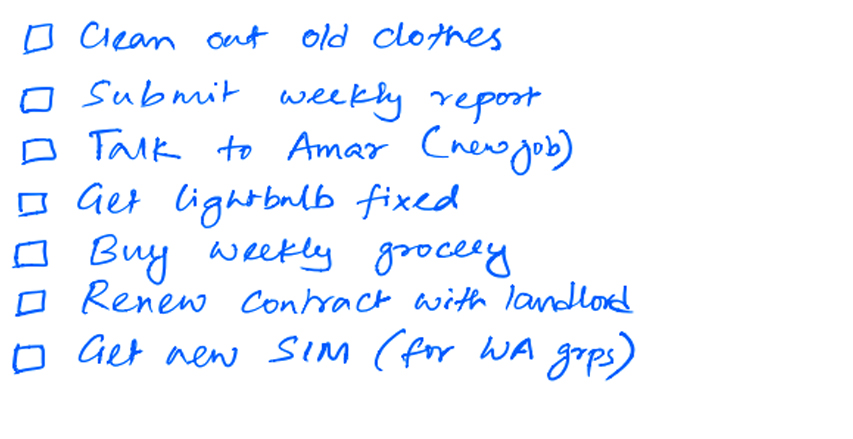
You can guess what will happen when you sit down to study with all these pending tasks on your mind. Your brain doesn’t really differentiate between what is important and what is not.
You will constantly worry about small things that you need to do before you can focus on the GMAT.
So what you need to do is take that checklist and put some dates and times against it.
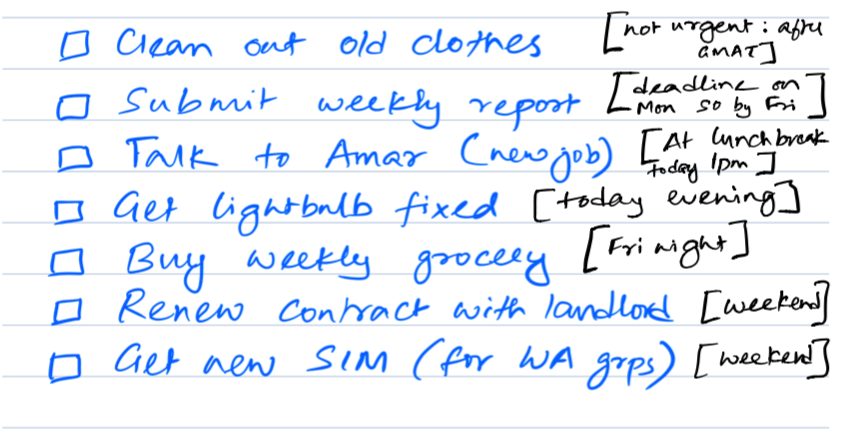
This way, when you are studying for the GMAT, you can put your mind to rest by telling it that you have got it all figured out and that you will get it all done at the appropriate time.
Note: the best way to get your job done is to put it on your calendar. That way, you will know that a reminder will go off when it is time. The brain is not particularly good at remembering when to do stuff. It is good at panicking when you don’t do it! 🙂
3. Make sure you have all the necessary and right resources with you before you start to study for the GMAT
There are plenty of resources for you to resolve your doubts, but (later in this article), we will pick the top ones that are guaranteed to help.
Here is why you should be worried about the quality of your study material:
There are plenty of resources out there! GBs worth of videos, thousands of discussion threads, and enough questions to solve till the next decade!
Here is a piece of advice (actually two):
First, stick to official material for solving!
Did you know that the GMAC spends close to $2000 to create a single GMAT official question?
No test prep company in the world can do anything close to that. None of the practice questions can replicate the elegance of the real GMAT questions; none of the mock GMAT tests available online can simulate the actual GMAT scoring algorithm.
Second, learn to use forums wisely!
A lot of students spend way too much time reading posts from other students who are equally clueless.
Or they spend a lot of time reading through endless discussions on ambiguous questions that are most certainly not official questions (another reason to stick to only official material!)
4. Ensure that you are not connected to the Internet while you are studying for the GMAT
A corollary to the above point is that the Internet itself can be a pretty terrible place for your GMAT preparation.
Preparing for the GMAT requires focus. The Internet is about distraction.
Preparing for the GMAT needs quality. The Internet is notorious for poor quality.
Preparing for the GMAT is unitasking. Browser tabs were invented for multitasking.
In short: the Internet can mess up your GMAT preparation.
Of course, we are not saying that you shun the internet altogether. You’ll soon see that there are a lot of resources that will certainly help you.
However, do not open ANY other tabs or windows while studying for the GMAT. It is hard enough to study for the GMAT; it is worse when the latest apps are vying for your attention!
Also, it is best to keep your phone on silent (really nothing urgent will happen in those 60-120 minutes that you’ll be studying. So don’t check WhatsApp or Instagram to “take a break”.)
If you want a break, drink a glass of water and stretch your legs!
Note: In general, it is a great productivity technique to turn off all notifications on your phone. They are designed to “notify” and distract you.)
Part C: How to study for the GMAT given that your needs as a working person are different? (by understanding the 3 phases to prep!)
Now that we have covered ways in which you can focus, the crucial part is HOW! What you need to understand is that GMAT prep can be broadly divided into 3 phases:
Phase 1: Understanding the concepts
At this level, you need to understand the various concepts tested on the GMAT. The good news is that you don’t need any Math concepts beyond the 10th-grade level. And on Verbal too – there is very little, in terms of concepts, that gets tested on the GMAT. To know the list of concepts tested on the GMAT look up our resource here: GMAT Syllabus. So essentially, on the GMAT, you need to know the following:
For Quant:
1. Arithmetic concepts such as rate, %ages, ratio, and counting principles
2. Algebra concepts such as equations, inequalities, and absolute values
3. Geometry concepts such as lines, circles, and coordinate geometry
For Verbal:
1. Structure of an argument to understand critical reasoning questions
2. Ability to read and comprehend a passage to solve reading comprehension questions
For Data Insights:
1. Interpreting charts, graphs, and tables to extract relevant data and identify trends
2. Understanding descriptive statistics such as mean, median, standard deviation, and basic probability concepts
3. Evaluating statements for data sufficiency and applying logical reasoning to make data-driven conclusions
Apart from these basics, you don’t really need much. Remember that the GMAT is not a test of knowledge or memorization. The total amount of concepts required for you to do very, very well on the GMAT is relatively finite.
For example, the IAS exam in India is notoriously tough just because it requires you to remember a LOT of things. The GMAT doesn’t expect you to remember much.
In fact, all the quant formulae needed for the GMAT can be summarized in a single sheet of paper. However, that is not going to help you much—you are not going to crack a perfect score in Quant by knowing all the theory.
This is where a course such as the Crackverbal’s GMAT weekend classes online course helps.
We understand that working professionals need bite-sized “snackable” pieces of information. Our videos are typically around 6-10 minutes long and cover just one concept in each video.
That is where the next phase comes into play.
Phase 2: Applying the concepts
You must understand the mechanics of what GMAT is trying to do here. GMAT knows that most test-takers know the basics, but it is trying to figure out how well you can apply those concepts in day-to-day decision making.
Let’s say that you want to be a consultant after your MBA.
Your job will require you to read copious amounts of data but not remember all of it. All you need to do is summarize it (“What is the main idea?”) so that you can answer any question thrown at you (“What can we infer from so-and-so statement?”).
This is nothing but Reading Comprehension.
But you are not going to get paid just to crunch all that stuff you’ve read. You get paid to draw your inferences, your conclusion, your conjecture from that data (“Would this new development strengthen or weaken our position?”).
This is nothing but Critical Reasoning.
Wait, you are also expected to understand how data functions (“What would be the minimum number of shipments needed?”). You guessed it right: this is Problem Solving.
Sometimes, you are expected to understand the impact of the given data on the problem at hand (“Which additional data point would help us answer the question?”)
This is Data Sufficiency.
So, what you realize is that the GMAT is really testing you on real-world skills. Skills that you would have already built during your corporate experience. All you need to understand is how to approach each question type and what tactics you need to eliminate the wrong answer options.
The best way to practice (as we said above) is to stick to only the official material for GMAT.
You could use a set of Official Guides (these are the BEST set of questions to practice from). These contain actual questions that were tested on the GMAT (and since then retired). This gives you a very good sense of what the GMAT will test you on.
GMAT has also released a book of Advanced Questions—questions that you would encounter once you are at the 635+ range on the GMAT.
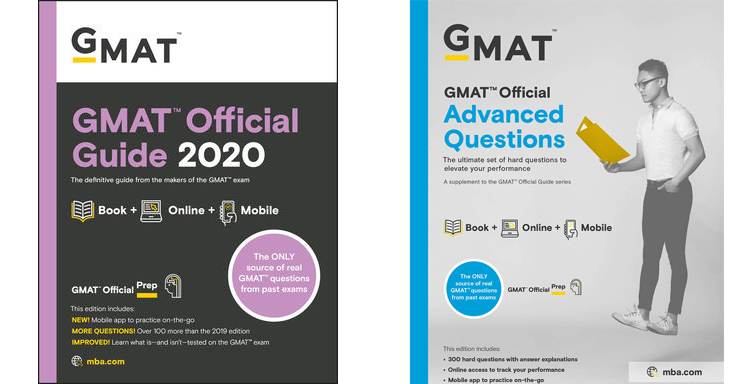
There are about 400 questions in all these 5 books put together. That is a LOT of practice. And certainly, enough practice questions for you to understand how GMAT tests you on each concept in Verbal (Critical Reasoning, and Reading Comprehension), Quant (Arithmetic, Algebra), and Data Insights. The reason we are suggesting you pick a physical book is so that you can sit and focus on solving questions.
Phase 3: Optimizing your performance
Okay, so there is one more part that you need to consider: you need to solve all of these questions in a LIMITED time to MAXIMIZE your scores. Let us focus on the two points in detail below:
1. Limited Time:
You have the following time constraints:
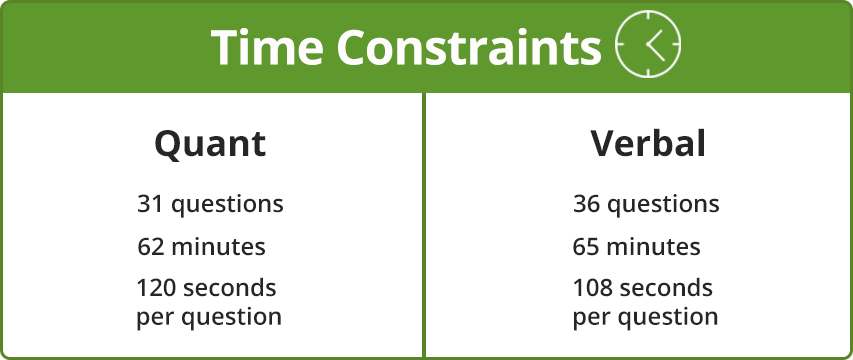
Now to solve a question with no time limit means that you need to focus on solving the question. The way in which you arrive at the right answer doesn’t really matter as long as you know how to get to the right answer.
The problem while preparing for the GMAT is that it DOES matter what approach you take to solve a problem.
An approach that can solve a question in under a minute is definitely preferred over an approach that is going to take you 2.5 minutes. So, while solving questions, it is important for us to ask the right question.
Wrong question: Can I solve this question?
Right question: Can I solve this question under 2 minutes?
2. Maximize your scores
Remember that the objective on the GMAT is not to answer all the questions correctly but to answer the maximum possible questions in the most efficient way.
What is “efficient”?
Glad you asked! 🙂
Let’s take 2 scenarios: In one section, John gets questions 3, 10, 15, and 21 wrong.
On the same section, Jane gets questions 14,15,16, and 17 wrong.
Both have answered 4 questions incorrectly – would they get the same score? They won’t! The answer to that lies in the way the GMAT algorithm works.
Both of these skills are developed by practicing using Official GMAT mock tests.
This involves knowing which questions are worth your time and which questions need to be “guessed” intelligently. At this point, all you need to know is that we need to have a strategy that would allow us to guess at appropriate times to maximize our chances of a better score.
To get better at managing your time and maximizing your score, you can practice with the 2 free official tests available at MBA.com. (You think 2 isn’t enough? You can purchase 4 more tests too!)
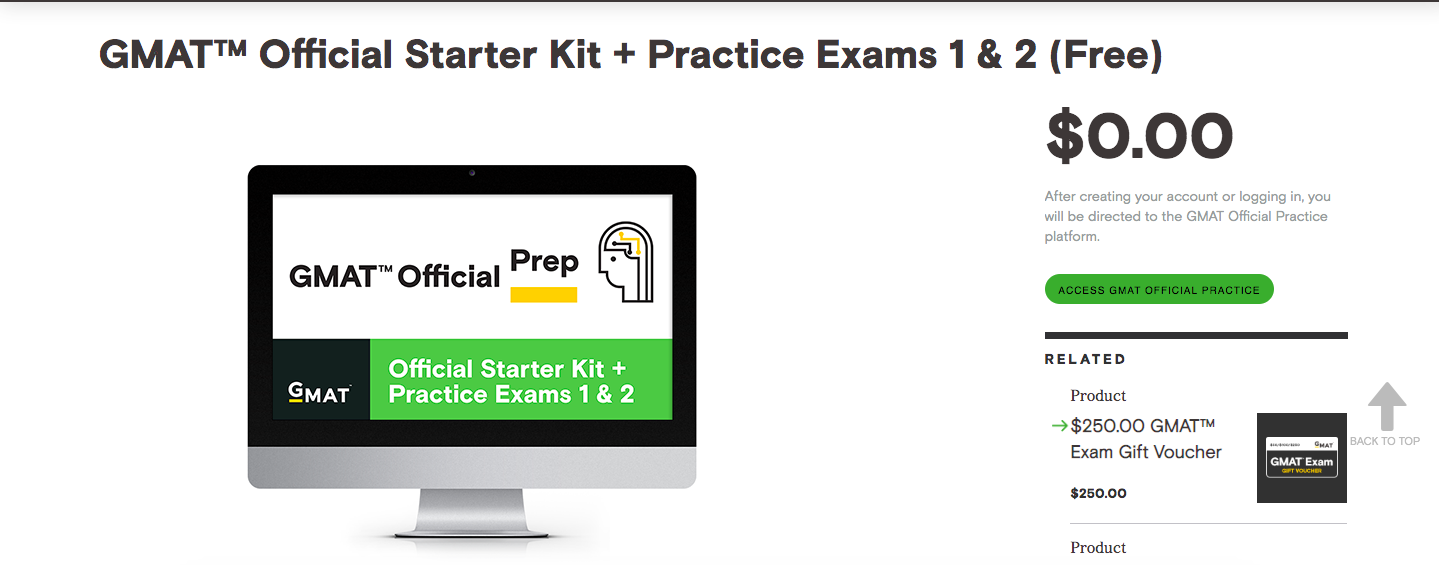
Remember that this is the only full-length adaptive practice exams created by the maker of the GMAT exam available anywhere online.
You can also flex your GMAT muscle by trying out the Official Guide Tests in the Crackverbal Learning platform.
Along with these timed tests, you also get access to the video and text explanation of all the official GMAT questions from the latest Official Guide. These explanations are a must-have because they give you the solutions from a test taker’s perspective.
Secondly, we have a ton of GMAT strategy videos on our YouTube channel (these are hardcore GMAT strategies—not flimsy videos that waste your time!)
Now that you have all the resources at your disposal, you can really focus on preparing for the test!
Part D: What is the most optimized GMAT study strategy/plan? (for people with full-time jobs)
Now let’s understand how you can put all of this together and make a plan that best suits you.
Here are a few things to consider:
1. How many hours of GMAT preparation is needed if I am working full-time?
To be honest, your brain uses up a lot of energy to process the GMAT questions. This means it is easy to get exhausted quickly when you sit down to study. However, with practice, you will be able to improve your stamina on the GMAT.
To use a rule of thumb—around 2 hours per day is just about enough for you if you devote your time consistently , and study for the GMAT
Of course, if you have the whole day, then you can study for say 3-4 hours. That would be a couple of 2-hour stretches of prep.
But don’t overdo it because if you try to study more than what you can absorb, you will end up:
- not understanding why you made a particular error. Your brain will focus only on “doing” and
- not on “understanding”. It is like chewing food but not digesting it properly. This means that you will not see any improvement in your test scores/performance.
- not reviewing your performance. Once you have reflected on your performance, you can make appropriate course corrections and apply the new knowledge on fresh questions.
- finding yourself exhausted. You will start with a few days of setting your alarm at 4 a.m. but quickly lose steam. You want your prep to be consistent!
2. What are some effective study strategies and tips if you are studying for the GMAT with a full-time job?
Firstly, it is important that you understand the importance of having a routine.
We know that you have a tough schedule, but the best way for you to study is to pick a time slot as we mentioned earlier, and sit quietly with zero (or near zero) distractions.
However, having said that, we also understand that sometimes if you have access to the right content and a good Internet connection, you can even study while you are commuting to work or while you are the gym.
Picking the right time and place will solve half the problems! Once you have the right routine, studying for the GMAT will become a habit.
Secondly, remember that it is not about QUANTITY but QUALITY.
Without analyzing where you went wrong, solving questions is of no use. Remember that none of the practice questions will be repeated on the GMAT. So, it is important to utilize your precious time wisely.
Remember to ask yourself the following 3 questions if you want to improve your GMAT score:
- Did I understand the underlying concept that was tested?
- Was I able to eliminate the wrong options for a good reason?
- Could I identify and avoid the traps in the question?
3. What is the total time required for GMAT preparation along with my job?
Our advice is to give yourself anywhere between 2-3 months to prepare for the GMAT.
The difference in preparation time depends on a lot of things such as:
- The number of hours you can devote to preparation every day/week/month. Some weeks you could have a lot of work in the office. Sometimes, you might just fall sick. Some days you might have relatives visiting.
- Your starting base—some people get a 700 on their first diagnostic test while some get 300. The journey would change vastly based on the number of areas you need to fix. Some students start off very strong in Quant. Some start with a strong base in Verbal. And some start with none.
- Your competence—some students tend to pick up things very quickly. Some need a bit more time to understand the concepts. The speed of your journey doesn’t matter; what matters is your preparation and ability to get your dream score.
Here we are giving you a simple 3-month study plan
1. What is the best way to kickstart your prep?
A big question that a lot of people have is: if there is so much prep material out there, why should we even consider professional help for the GMAT?
That is a great question and one that you need to answer for yourself.
Let us try tackling a few aspects:
2. Should I prepare by myself or take up GMAT coaching?
What good GMAT coaching does is that it gives you a couple of distinct advantages.
For starters, you get to learn the concepts, techniques, and strategies needed for the GMAT. At Crackverbal, we provide a 3-month study plan that is designed to keep you on the straight and narrow.
You can prepare by yourself too—the only catch is that if you listen to the wrong advice or end up picking the wrong technique, then you would not only get frustrated with the lack of progress but also waste your precious time (time really is your most important resource—even more than money).
3. Should I take classroom coaching or an online course or personal tutoring?
Classroom coaching has been around for many years now and is for people who don’t have a problem traveling to a coaching center. The main thing to consider would be the experience and quality of the instructor.
Online coaching is great for you if you have the drive to maintain focus in front of your computer (as we mentioned earlier—also your biggest source of distraction!).
The main thing is that the online program needs to have enough sticky-ness to ensure that you complete the program.
The Crackverbal GMAT Online Course is designed with the working professional in mind—so you know it is tailored to meet your needs.
Personal tutoring is great if you want one-on-one help to fine-tune your approach and strategy on the GMAT. A GMAT coach would work with you to understand your strengths and weaknesses to ensure that you are on the optimal path towards success.
The Crackverbal GMAT Personal Tutoring program gives you access to top GMAT trainers in the country—each trainer with 100s of hours of teaching experience and a rock-solid GMAT score to boot!
That’s a wrap, folks!
Did you like this article? If so, do let us know in the comments below.
If you think there were pieces you want to revisit later, then make sure you bookmark this page so you can check them out later.
If you would like to share this article with your friends on WhatsApp, you can do so by clicking here.
If you want to dive deeper into your study plan and get some insights into where you could improve your strategy, get in touch with us.
Speak To Our Expert GMAT Advisors.
Speak To Our Expert GMAT Advisors
Your target score starts with
one expert call.
A free 30-minute call. We'll audit your prep, find your gaps, and build a roadmap to your target score.